
Kaleto Fortress,Bulgaria
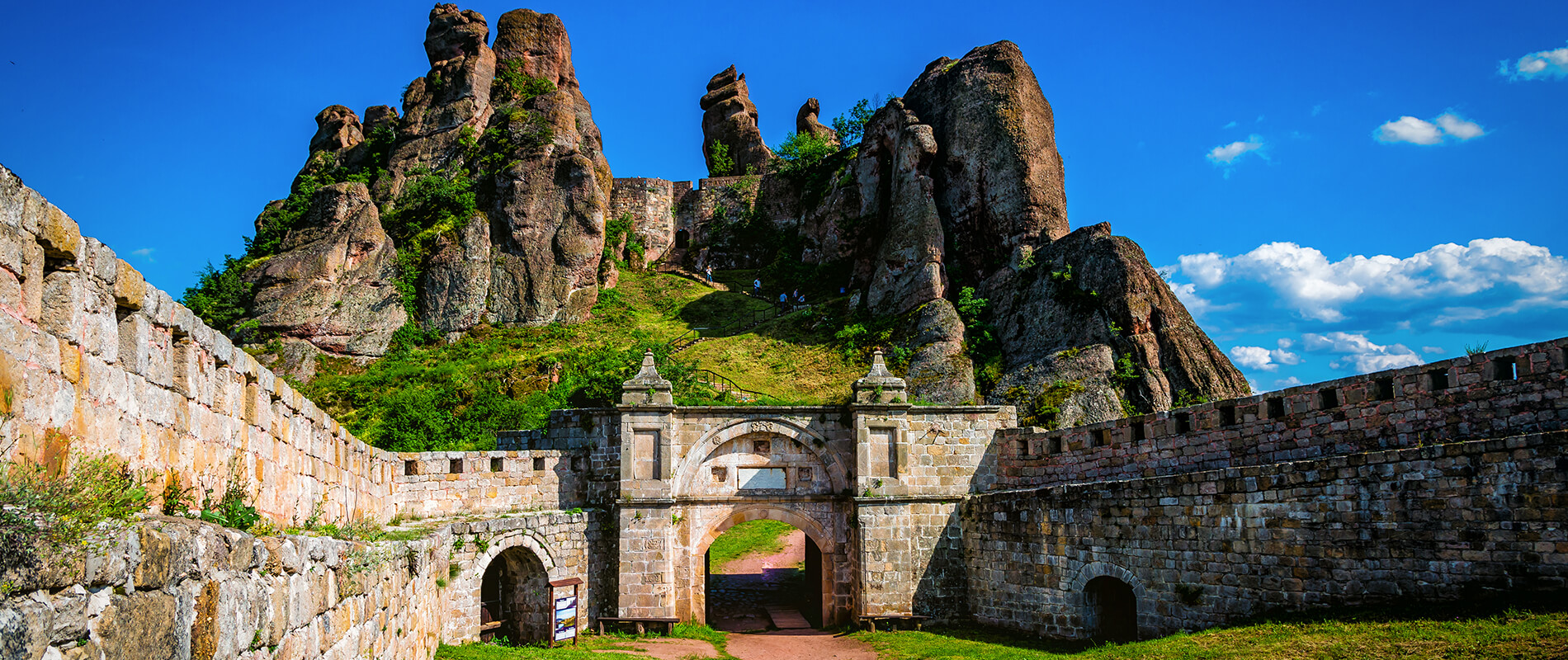
In the northwest of Bulgaria, just steps from the border with Serbia, lies Belogradchik. The town does not appear on mass tourism routes, yet it is nestled among the western Balkan Mountains, about 180 kilometers from Sofia. The true focal point, however, is not urban but geological. Here the Balkan range fractures into a surreal sequence of reddish sandstone and conglomerates, shaped over two hundred million years by atmospheric forces and tectonic movements. Rising above this lunar landscape, already a geological rarity in itself, stands the Kaleto Fortress. It is not perched on just any hill. It is stitched into natural stone spires. Rock and wall merge into a defensive embrace that no architect could have designed alone. Nature first carved towers of stone. Humans later transformed them into bastions.

The earliest walls are Roman, dating back to the third century AD. However, unlike the rigidity of Roman military camps, the builders adapted to the cliffs, using rock blocks deposited by glaciers as natural bastions. In the centuries that followed, Byzantine, Bulgarian of the Second Empire, and finally Ottoman layers were added starting from the fourteenth century. Each dominion left a fragment without ever imposing a complete reconstruction. The result is a defensive palimpsest unique in Europe.
What strikes the attentive observer from a technical standpoint is this: the three inner courtyards, lower, middle, and upper, are not connected by linear military paths but by narrow ledges and passages carved directly into the living rock. As one ascends toward the upper fortress at around 700 meters in elevation, it becomes clear that the sandstone blocks were not simply embedded into the walls. They function as walls themselves. In some sections, medieval masonry ends abruptly against a thirty meter spire, and the spire continues the role of a parapet.
The rock formations create natural angles for crossfire. Anyone approaching from the southern slope would not encounter a uniform wall but a vertical labyrinth of natural towers and arrow slits. The Ottomans understood this well. They reinforced the fortress between the fifteenth and nineteenth centuries without ever straightening or regularizing the existing structures, preserving the original anomaly.

Today access to Kaleto begins from the center of Belogradchik and follows a path that in twenty minutes leads beneath the first outcrop, the Madonna, a ten meter formation that stands like a stone sentinel. Next come the Twin Towers and the Camel, folkloric names for what is in reality pure tectonics. Inside the lower fortress, the absence of excessive restoration leaves the original stones visible, only lightly reinforced. Silence is broken only by the wind whistling through the pinnacles. Climbing to the middle courtyard, the view opens across the Belogradchik plain and the mountains stretching toward the Danube. The most intense moment comes in the final stretch: a narrow staircase carved into the rock leading to the upper fortress, dominated by a fifty meter sandstone block known as the Monk. From there, other formations such as the Maiden, the Bear, and the Knight appear like a petrified army.
Kaleto is not merely visited. It is inhabited for an hour, moving between walls and rock until the boundary between human work and natural form disappears. For those drawn to singular places, it stands as one of Europe’s high points, not the tallest or the largest, but the most precise in its synthesis. A flashlight, a windbreaker, and at least two hours of exploration offer the experience of walking inside a single, vast geostrategic work of art.

"The photos on this site are owned by users or purchased from image banks"
#Castle
You may also like
 Casina Vanvitelliana,Italy


You may also like
Casina Vanvitelliana,Italy

Do you want to receive news, promotions and all the exclusive contents by MyBestPlace? Subscribe our newsletter and get ready to travel!